International software manufacturer
Savings of € 440,000 per yearAI-powered support chat in 24 languages to reduce manual support load and support costs.
Learn more

Enterprise at bluetronix is aimed at companies where efficiency and scalability are a priority: We develop tailored architectures focused on measurable cost reduction with clear, traceable ROI.
The following case study examples show that the investment often pays off within the first year. Significant costs can be saved through implementation, while existing employees generate higher revenue. Additionally, the use of AI-driven translations allows access to new markets. Customer satisfaction noticeably increases while support effort sustainably decreases.
Every unnecessary click incurs additional effort and costs – every automated step reduces costs, minimizes errors, and relieves your employees. The following business cases illustrate how significant this effect can be in practice:
Every unnecessary click incurs additional effort and costs – every automated step reduces costs, minimizes errors, and relieves your employees. The following business cases illustrate how significant this effect can be in practice:
AI-powered support chat in 24 languages to reduce manual support load and support costs.
Learn moreMigration from an external sales platform to a proprietary enterprise auction platform (including live auctions) to permanently eliminate fees and enable growth.
Learn moreFrom manual email handling to a centralized portal with process automation – for higher throughput, better customer experience, and significant revenue growth.
Learn moreCentralization and automation of service processes (spare parts, complaints, maintenance) via a self-service portal with a workflow engine.
Learn moreScaling a monolingual online shop to an international e-commerce platform with AI-supported automation across the entire value chain.
Learn moreAI-powered support chat in 24 languages to reduce manual support load and support costs.
Annual support costs of around €600,000 due to multilingual phone support as well as email/form support. Many recurring standard queries had to be handled manually.
AI chat assistant in 24 languages that handles inquiries and answers up to 76% independently. Unresolvable topics are forwarded to human support – including pre-qualification (category, context, summary) and optional AI translation into the employee's language.
Migration from an external sales platform to an own enterprise auction platform (including live auction) to permanently eliminate fees and enable growth.
The auction house generated around €7.2 million in revenue per year, but offered its items through an external platform. This incurred an average of 8% platform fees – equivalent to about €576,000 per year. The platform was also only available in German and English.
Introduction of an own auction platform on a bluetronix system – including live auction, dedicated customer support, newsletter, and significantly expanded internationalization.
From manual email handling to a centralized portal with process automation – for higher throughput, better customer experience, and significant revenue growth.
Only about 70 company formations could be processed monthly (revenue per formation approximately €10,000). The entire process was handled manually via email: order, payment, document request, signatures, status inquiries, as well as reminders and extensions. Different employees communicated in parallel – customers lost track, leading to dissatisfaction and additional support effort due to frequent inquiries about processing status.
Introduction of a customer-based web portal with personal access area and centralized processing in the bluetronix CMS. Inquiries no longer land unstructured in inboxes, but uniformly and orderly in one system.
Note on magnitude: At about €10,000 per establishment, scaling from ~70 to ~250 establishments/month corresponds to a potential revenue increase from about €600,000 to €2,500,000 per month (depending on package mix, cancellation rate, and seasonal effects).
Centralization and automation of service processes (spare parts, complaints, maintenance) through a self-service portal with workflow engine – aimed at reducing operational costs and relieving teams.
An internationally operating industrial company handled service cases (spare part requests, maintenance, complaints, technician deployments) via email, phone, and several Excel sheets. Frequent inquiries ('Status?', 'What documents are missing?', 'When will the part arrive?') generated high processing times, media discontinuities, and errors. The operational burden led to rising costs and dissatisfied customers.
Implementation of a centralized service platform based on bluetronix: self-service portal for customers and partners, workflow engine for internal processes, and a unified processing board for all cases. The platform ensures that inquiries are fully received, accurately categorized, and customers can always see the status.
Economics: One-time project costs €320,000 plus operation €5,500 / month (= €66,000 / year). With an annual net saving of approx. €500,000, the investment pays off in about 8 months (€320,000 ÷ (€500,000 / 12)).
Scaling a monolingual online shop to an international e-commerce platform with AI-supported automation across the entire value chain.
The online shop was originally set up in one language and heavily relied on manual processes. Customer inquiries, shipping cost calculation, logistics coordination, inventory management, and shipping label creation required numerous manual interventions. This led to high staff expenditure, error susceptibility, and limited international scalability.
Implementation of a comprehensive e-commerce and logistics platform based on bluetronix with a strong focus on AI automation.
Economics: One-time project costs €470,000 plus €7,500 / month operation (= €90,000 / year). Despite ongoing costs, there is a sustainable annual saving of approx. €300,000 as well as additional revenue potential through international reach.
A server with a centralized web application is ideal for digitizing your business processes because it maps processes end-to-end – without media breaks, manual double entries, and system silos. Unlike local ERP installations, a server is immediately accessible worldwide, scalable, and designed for cross-location teams, partners, and customers. While local ERP systems can be integrated, they often require VPN structures, complex security concepts, additional interfaces, and ongoing administrative effort.
Moreover, a modern server environment provides an excellent foundation: it is powerful, stable, and secure, and comes with many proven standard components. This allows for reliable automation of business processes and controlled development.
Following this principle, the path to "digital ERP" at bluetronix has developed: the starting point was online shops that initially automated invoice creation (e.g., PDF generation). Many companies then realized that the combination of CMS provider X, CRM provider Y, and ERP provider Z caused unnecessary time, costs, and coordination effort – mainly due to interfaces, duplicate data storage, and manual handovers. Consequently, the development of an integrated system that maps the entire business process on a single platform emerged.
A typical example: Why should customer data from a shop order later be manually transferred to a local inventory system when the customer registers in the web portal and keeps their data up to date there? If customer account, order, invoice, and process status occur in one system, invoice creation can take place directly on the server – traceable, automated, and without media breaks.
Additionally, there is a pragmatic advantage: portal servers are typically dimensioned with excess capacity to handle spikes in access. Since these peaks only occur temporarily in practice, the existing performance reserve can be effectively utilized to operate ERP and process workflows efficiently.
In many companies, hidden costs arise due to manual processes, media breaks, and lack of automation. Our consulting is the first step to identify and specifically reduce these potentials.
Non-binding consultationIn an enterprise project, the visible website, i.e., the frontend, usually only accounts for a fraction of the total costs. The majority of the investment does not go into the design of the pages, but into the system behind it – that is, into processes, logic, data flows, and automation.
How do articles or content get onto the website? What actions can a user take? Can they register, update their data themselves, and do these changes flow directly into customer management? Does the customer see their orders, payments, invoices, and the current shipping and delivery status? Can they initiate returns independently – and how are these returns processed, recorded, and tracked internally? Information close to production and inventory, such as stock levels, packing status, or availability, also play a central role here.
The website serves as the user interface for a complex system: it is the portal through which customers, partners, or employees interact with the ERP, CRM, PIM, and logistics backend. It is this interaction that makes digital business processes efficient, scalable, and economical.
Of course, there are scenarios where a significant investment is also made in the frontend – such as in auction platforms, B2B portals, or high-frequency transaction sites. Here, additional budgets are spent on real-time updates, dynamic price and status displays, timed or live auctions, performance optimizations, and user guidance. However, even in these cases, the frontend remains part of the whole – the real added value comes from the system architecture behind it.
Many of our enterprise projects involve sensitive business processes, system landscapes, and data. Therefore, they are subject to strict confidentiality agreements (NDA). Instead of name-dropping, we focus on what matters: measurable results, clearly understandable profitability, and a collaboration that is sustainable in the long term.
Viele unserer Projekte unterliegen strengen Vertraulichkeitsvereinbarungen. Details erläutern wir gern im persönlichen Gespräch.
Typical savings potential arises where daily manual steps, media breaks, and inquiries occur. The following examples show how processes can be measurably simplified through digitization and automation.
Employees scan items via the app instead of manually entering item numbers. This almost completely reduces confusion and input errors, saving time during goods receipt, picking, and shipping.
All employees access a centralized, database-based item management system with consistent data in real-time. This prevents duplicate maintenance, reduces coordination efforts, and improves data quality.
As soon as an order is packed and shipped from the warehouse, the inventory automatically updates in the shop. This prevents overselling, incorrect delivery times, and manual corrections.
Item and order data are exchanged automatically between systems via import/export or APIs. This saves manual data entry and reduces errors in master data.
AI supports the optimization of item lists, descriptions, and variants. This reduces maintenance efforts, improves structure, and ensures consistent product data.
Item texts and important content are translated with AI support and centrally maintained. This allows you to tap into new markets without proportionally increasing maintenance efforts.
Cropping, background removal, and format adjustment of product images are done in series with AI support. This saves significant time per item and accelerates product range expansion.
Recurring questions are answered automatically; complex cases are handed over to support with context and summary. This significantly lowers ticket volume and processing time.
Scanning processes guide packing teams during picking and shipping. Mis-picks are prevented, shipping errors are reduced, and throughput increases without a proportional increase in staffing.
Status updates via email, SMS, or push notifications, including portal overview, reduce inquiries ('Where is my delivery?') and relieve support and back office.
Invoices are automatically generated from orders and correctly passed to accounting systems. This reduces errors, inquiries, and manual exports.
Incoming payments are reconciled, open items are updated, and dunning processes are triggered based on rules. This saves time and reduces receivables defaults.
A customized back-office creates order, speed, and transparency in all core processes—from customer management to billing. Instead of isolated solutions and manual double maintenance, you get a central platform that is precisely tailored to your workflows and utilizes automation where time and costs arise daily.
Ergebnis: weniger manuelle Schritte, weniger Fehler durch Medienbrüche und ein System, das mit Ihrem Unternehmen skaliert – ohne dass interne Abläufe bei Wachstum immer mehr Personal und Abstimmung kosten.
We create your individual app for iOS and Android and publish it under your company name or desired app title directly in the app stores. Having your own app significantly strengthens customer loyalty and offers maximum convenience to your users: After a one-time login, access is permanently stored – no need to log in repeatedly. Customers benefit from quick, direct access, for example to an online shop, an auction system, internal item orders, or personal wish lists. These functions can be used much more conveniently and intuitively via an app than through a traditional web portal. For your company, the app offers additional security benefits, as employee access is device-related and devices can be clearly identified.
Another significant advantage of having your own app lies in its internal use by your employees. Through the integrated user system, authorized employees receive extended, role-specific access possibilities to your enterprise system. This allows for individual and automated workflows to be represented directly in the app – such as scanning items, managing delivery and order status, or obtaining digital signatures from customers on smartphones or tablets during pickup or handover. Even complex, company-specific processes can be targetedly implemented in a tailored app. The result: more efficient workflows, fewer sources of error, faster processes, and significantly higher productivity in everyday work.
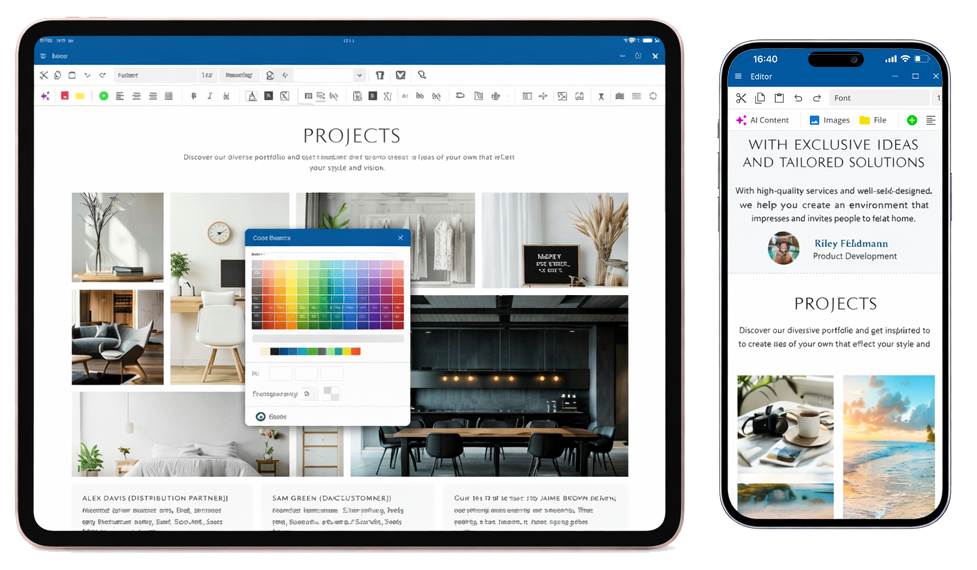
With bluetronix CMS, you maintain all content centrally in one place. Changes to articles, texts, or paragraphs only need to be made once and are instantly visible everywhere: on the website (phone, tablet, and desktop views) and in the app. All app content is directly controlled from the CMS, which means no app update is required when only content changes. This ensures efficient, time-saving, and consistent management of all data and represents a decisive advantage of centralized content and article management.
Enterprise projects require a clearly structured, transparent process – from the initial request to stable operation. That’s why we work with a proven approach that clearly separates analysis, planning, implementation, and operation. The goal is to identify risks early, make decisions that can be traced, and ensure that the system consistently fits your business processes. The following process shows how we implement and operate enterprise projects in a structured manner.
You submit a request with a rough objective description (industry, target audience, functions, deadline, budget framework).
We assess feasibility, risks, technical framework conditions, and dependencies (e.g., interfaces, hosting, data protection).
Workshops/Calls with you and our team: objectives, requirements, priorities, stakeholders, processes, content, design wishes, success criteria.
Specification document including user stories/use cases, roles & permissions, functions, integrations, data models, acceptance criteria.
Architecture, tech stack, interfaces, hosting/cloud, security concept, monitoring/logging, scaling, backup/recovery.
Information architecture, wireframes, clickable prototype, design system/components, responsive design, accessibility basics.
Roadmap, milestones, timeline, team/rates, scope of services, assumptions, optional packages (support, maintenance), payment plan.
Service description, change request process, SLA/support, data protection (AVV), rights/licenses, acceptance and warranty rules.
Sprints/backlog, repo & CI/CD, dev/staging/prod, definition of done, communication and reporting rhythm.
Development of frontend/backend, content, integrations, migration (if necessary), demos/reviews, ongoing QA.
Unit/integration/end-to-end, security checks, performance, accessibility, cross-browser, test logs.
UAT with you, bug fixing, acceptance per milestone, go-live plan, rollback plan, tracking/analytics, content check.
Deployment, monitoring, incident management, hotfix window, performance fine-tuning.
Admin/Editor documentation, technical documentation, training, business processes, clean handover of accesses/keys.
Updates, security patches, backups, SLA, further development according to roadmap, optimization of SEO/performance/UX.
Note: Depending on the actual framework conditions, the specific project process may differ in practice.
For enterprise projects, you need not a rigid standard product, but a toolbox of proven components, precisely tailored to your processes. That’s exactly what bluetronix is built for: stable standard modules for speed and cost control – supplemented by individual components for your requirements.
Operational concepts, performance, and security are tailored to your data flow and processes – from a single server to a scalable cluster architecture with clear backup and recovery strategies.
Proven basic modules for typical enterprise areas such as users, rights, content, workflows, data objects, and interfaces – as a stable basis for quick implementation and predictable costs.
Where standard ends, enterprise begins: We develop tailored modules for your workflows – e.g. portals, automations, document logic, specialized workflows, or connections to ERP/CRM/ticket systems.
Mobile components like login, roles, scan/barcode, push, forms, uploads, and status views – ideal for logistics, service, field service, or internal processes with high frequency.
If your project requires a dedicated app, we implement a custom employee or customer app – including portal logic, notifications, self-service, workflows, and secure system integration.
AI chat assistant, knowledge base/vector store, translations (up to 24 languages), pre-qualification, summaries, and AI-driven optimizations – for measurable relief and scalable processes.
A powerful system of components that is quickly ready to launch, can be flexibly expanded, and models your processes in a way that automation actually works – efficiently, securely, and maintainable in the long term.
We have more than 20 years of practical experience in the complete digitization and automation of our own business model – the bluetronix CMS package hosting – as well as in numerous customer projects. Our CMS serves as a robust reference for our expertise in the digitization of business processes. This enables us to understand your requirements not only technically but also operationally and procedurally, and to deliver practical, sustainable solutions.
For over 20 years, we have been developing scalable server and CMS solutions – including our own app development.
bluetronix CMS has been continuously developed since 2002 and is used by thousands of customers worldwide in 24 languages.
Since 2002, we have been supporting platforms with many end customers, high transaction volumes, and critical processes.
An international team of highly qualified developers ensures rapid implementation, clean architecture, and long-term maintainability.
Global server locations enable performance, scalability, and suitable operating models – depending on region and requirements.
From hosting to server operation to enterprise solutions, we handle everything internally – without external subcontractors.
Note: Many projects are subject to NDAs. We are happy to discuss details of comparable implementations in a personal conversation.
For digitization, automation, and modern web portals – we check eligibility for funding.
Non-binding consultationbluetronix works cost-effectively with proven core modules that we specifically adapt to your requirements – instead of developing everything from scratch or forcing you into rigid standards. This way, you get a solution that fits your processes exactly, remains scalable, and makes economic sense.
I am currently using a 29-euro package. How can it be that bluetronix also implements enterprise projects with very high budgets?
bluetronix covers both the classic web package area as well as extensive enterprise projects. This means that the website builder and the overall system are based on a solution that has already been widely tested in daily use and is also flexibly designed so that very large and individual portals can be implemented. For smaller companies, this means they can start with a compact package and can grow with their business at any time without needing to change the system. For larger businesses, this means they can rely on a proven platform that is already used in many practical applications.
Why can a large project investment, such as in an enterprise solution, be economically worthwhile?
Such projects at bluetronix often serve the digitalization and automation of internal processes. The goal is to reduce manual processes, connect systems better, and make workflows more efficient. If, for example, support, administration, logistics, or other recurring tasks are significantly relieved as a result, the investment can quickly pay off economically. In larger companies, the benefit often arises not only from the visible website but especially from the optimization of processes in the background.
Why should an enterprise project be implemented with bluetronix?
bluetronix combines many years of experience with a platform that can be used for both smaller web projects and extensive enterprise solutions. As a result, solutions are created that are practically designed and can grow with increasing demands. Added to this are international deployment options, flexible server concepts, and a broad technical range of services for individual projects.
What role do custom apps play in enterprise projects?
Custom apps can be used in bluetronix enterprise projects both for end customers and for internal employees. For end customers, shops, portals, or custom services can be provided through them. For employees, additional special functions can be implemented, such as for inventory management, scanning functions, internal approvals, delivery lists, or other operational processes. This way, apps can not only strengthen customer loyalty but also significantly simplify internal processes.
What is the difference between a large enterprise project and a classic website?
The biggest difference often lies not in the visible design but in the functions and processes in the background. Of course, the frontend can also be implemented very high-quality in the bluetronix website builder, but in enterprise projects, what matters most is the overall system behind it. This includes, for example, server structures, performance, data throughput, ordering processes, back-office systems, logistics, interfaces, automations, notifications, and individual management processes. The real added value often lies in the technical and organizational foundation.
I already have a homepage and want to switch to bluetronix. Is that possible?
Yes, there are suitable import options for that. Content from your previous homepage can be transferred to the bluetronix website builder, also in a new layout if desired. You can then transfer your domain and manage your website directly through bluetronix.
Is bluetronix the right long-term decision?
Yes, bluetronix is designed for long-term use. The website builder and the platform cover not only classic websites but also extensive projects including portals, cloud server solutions, and back-office systems. Additionally, interfaces and custom extensions are possible. This way, you won't quickly hit limits with growing demands, and you won't have to switch to another system just because your business grows or requires new functionalities.
Is the bluetronix software suitable for beginners, or do I need programming skills?
Yes, the bluetronix website builder is also suitable for beginners. The system is easy to use, and there are many aids and tutorials available. Programming knowledge is not required. If you want, you can additionally work with HTML, PHP, or MySQL, but that is optional. You can also commission additional development and programming services from bluetronix if desired.
Is everything really included to publish my website?
Yes, with the bluetronix website builder, you get a complete system for publishing your website. You can log in through the CMS, the app, and the browser on PC, Mac, smartphone, and tablet. Your domain is also included. Once you have ordered your domain, you can directly publish your website. Email accounts and a database are already included, so you don't need any additional external software.
Can I test the website builder for free?
Yes, you can test the bluetronix website builder for free for 10 days. You can request your access directly through the browser or download the bluetronix app for iOS and Android. For the trial version, you only need an email address for verification. No further personal data or credit card details are required.