Choosing website software correctly and remaining flexible later
Choosing the right CMS ultimately determines flexibility, growth, and professionalism. Those who make the wrong choice today risk costly system changes, technical limitations, and unnecessary dependencies in daily operations.
The choice of the right CMS
Many companies first consider price, design templates, or how quickly the first website can go online when choosing website software. However, the real risk often only becomes apparent later. A CMS is not a short-term toy, but the technical foundation on which your content, your marketing, your shop, your customer communication, and often even internal processes will build for years. Those who choose the wrong system at the beginning usually don’t notice the disadvantages immediately but only when the company grows, new features are needed, or a system change suddenly becomes unavoidable. That’s why the choice of a CMS should always be thought of in the long term.
CMS - company scaling
The most important question is not what you need today, but what your system must be able to do tomorrow, next year, and in a few years. Many poor decisions stem from choosing website software only based on current minimal needs. For example, one might say that only a small website is needed at first and that it can later easily switch to another system if necessary. This mindset is often the start of a long-term problem in practice. A website is not just a collection of individual pages, but a growing system with content, structures, modules, connections, search engine values, user habits, and often also internal work processes. Therefore, you should check from the beginning whether the chosen solution will still be adequate if a shop is added later, a blog is established, newsletters are to be sent, customer portals are created, or even a back office system needs to be integrated. If this foresight is not planned from the start, it often costs double later.
Future system change
One of the biggest misconceptions when choosing homepage software is the assumption that later switching systems will be uncomplicated. In practice, it often looks quite different. For example, when switching from a provider with a certain CMS to a completely different system, the website often has to be set up almost entirely from scratch. Content needs to be re-entered, functions rebuilt, layouts integrated anew, and technical structures thought through again. Existing modules often cannot be easily transferred because they were developed to be system-dependent or because the new system lacks equivalent functions. Many things therefore have to be rebuilt manually. This concerns not only the visible part of the website but also internal processes, forms, data structures, user rights, shop functionalities, blog areas, or custom extensions. A system change is thus usually not a small technical step, but a significant reintegration effort with high time, cost, and coordination expenditures.
Many companies only realize during a system change that certain functions they have become accustomed to over the years are no longer available in the new system or can only be implemented with significant additional effort. Especially custom-developed modules, special shop logics, unique forms, protected areas, internal approvals, specific newsletter processes, or client-specific extensions cannot often be easily transferred. What was taken for granted in the old system must then be painstakingly replaced or even completely redeveloped in the new system. This can lead to the paradoxical situation where a supposedly more modern system ultimately offers less than the previous one. For this reason, when choosing a CMS, attention should not only be paid to current basic functions but also to how open, expandable, and sustainable the platform really is.
A particularly critical point in a system change is the alteration of file names, URL structures, and technical page types. Different systems often operate with completely different mechanics. Some pages may rely more on HTML structures, while others use PHP, and still others rely on ASP or ASP.NET. Thus, when switching, entire path structures, page calls, or file extensions often change. This has significant consequences. External links that have pointed to specific subpages for years may lead to nowhere. Already indexed pages lose their familiar structure. Search engines recognize that the technical foundation has changed significantly. Customers who have saved certain pages as favorites suddenly cannot access the content they expect. Even if redirects are set up, a system change often represents a major intrusion into the established visibility of a website. So, if you choose the wrong system from the start, you're not just making a short-term error; you often create a structural problem that can only be corrected later with significant effort.
cheap website builder
There are countless affordable homepage builders that look attractive at first glance. They promise a quick start, low costs, and easy handling. However, for businesses, this often provides a problematic foundation. Many of these systems are heavily restricted, technically inflexible, and may not always appear professional externally. It is often immediately obvious which builder was used to create the site because provider references appear in the footer or the entire appearance looks like a standard template. This can create a negative impression for customers. Presenting a business with a solution that resembles a cheap builder quickly sends the wrong signal. Visitors subconsciously wonder if a company, which is cutting corners on its digital representation, even values quality, reliability, and long-term professionalism. Particularly in a corporate environment, this can weaken brand perception.
free email providers
Another common flaw of cheap systems is apparent in external communication. When a company has its own domain but sends emails through outside addresses and unsuitable providers, the overall presence quickly appears inconsistent. A corporate website should always convey a professional overall impression. This includes ensuring that email addresses correspond to the domain, that the external appearance seems cohesive, and that customers do not get the impression that everything is just pieced together temporarily or cheaply. A website is never just design but always a signal of trust. If the software solution already looks like a cost-saving option, this trust is unnecessarily undermined.
technical extensibility
When choosing homepage software, it's essential to check what options the system will offer later. A company might start today with just a small website or a simple shop. However, in one or two years, the desire may arise to expand the shop, add a customer portal, integrate a blog, build an internal area, expand forms, send newsletters professionally, or incorporate processes like invoices, cancellations, inventory logic, or shipping statuses. Such developments are not unusual but are entirely normal for growing companies. This is why expandability is one of the most crucial criteria. A good CMS must not only provide modules today but also be able to incorporate new requirements sensibly later. Those who only buy for the minimal state often hinder their company's future development.
quality feature layout freedom
A very important point when choosing the right system is freedom in layout. Many cheap builders operate with a fixed number of templates that differ only slightly from each other. While this might suffice for private projects or very simple standard pages, it often represents a significant disadvantage for growing companies. Because it is precisely at the moment when a brand seeks to become more distinctive, when collaborating with an agency, or when a unique appearance needs to be developed that the ability to fully integrate a custom layout is necessary. Many systems fall short here as they can only function within their narrow range of templates. With our bluetronix CMS, this is different. The system has emerged from collaboration with agencies, and that is precisely why integrating custom designs is an essential part of the concept. Agencies can provide their designs in common formats like Figma, Adobe InDesign, or other typical design formats, and we can integrate these layouts individually into the system. This results in no builder appearance but a professional, brand-appropriate, and technically controlled solution.
Manage content independently
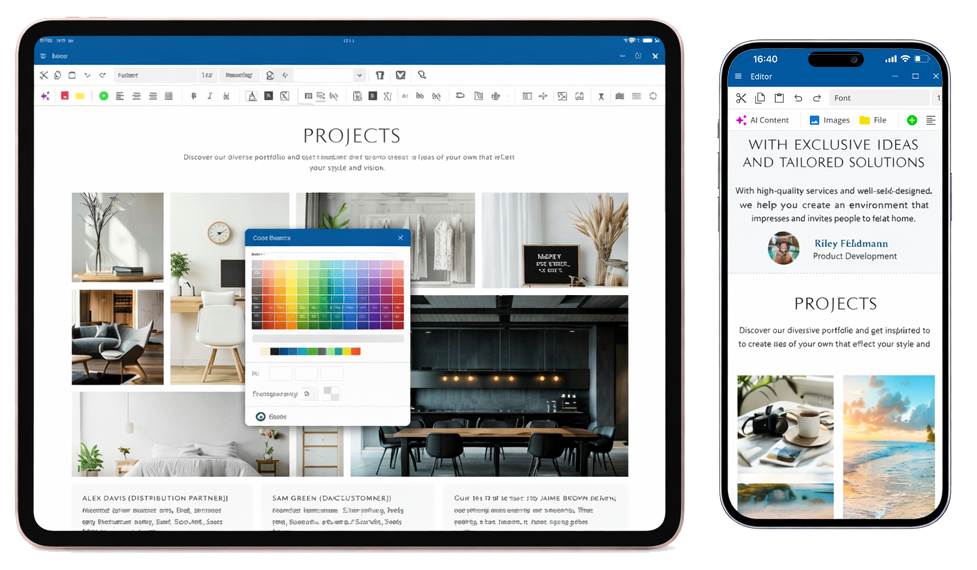
If even a small typo can only be corrected through detours, the system is too inflexible for everyday use. Another central criterion when selecting a CMS is how independently a company can later work with its own website. It is a significant disadvantage if every small change can only be made through an agency or an external service provider. Then, even minor adjustments become an unnecessary process. A typo must be reported, a correction prepared, a preview coordinated, approval delayed, and ultimately a minimal change can take days or even a whole week. For practical business day-to-day, this is intolerable. A good CMS must therefore allow for simple things to be changed at any time by oneself. This includes, for example, texts on the homepage, phone numbers, contact details, news, blog posts, newsletter content, or new sections. With the bluetronix CMS, clients can manage all their content independently. At the same time, the system is designed to keep entry options controlled and well-structured. Thus, the user can manage content without compromising the layout or undermining the professional design.
self-management with layout security
Many companies desire the freedom to manage their site themselves but are also concerned that this will make the layout chaotic or inconsistent. For this reason, not only the ability to change is essential, but also the way it is implemented. A professional system should give users freedoms but within clearly defined structures. In the bluetronix CMS, this is achieved through prepared templates and controlled content blocks. When a client wants to add a new section, they can rely on existing blocks and fill them with their content. As a result, the overall appearance remains consistent, high-quality, and technically stable. This creates a very important advantage: the company remains flexible in day-to-day operations without compromising the quality of its external representation.
technical expansion perspective
Anyone running a company with growth potential should not only think about content and design but also about technical expandability. A CMS should therefore not end in a rigid environment but be capable of growing with the company's requirements. Initially, it should be possible to start with a web package, later switch to a dedicated server, and even expand towards a cluster system as demands increase. Concurrently, the system must be open enough to allow developers to get involved to write their own modules, operate additional server applications, or implement custom extensions in technologies like PHP, Perl, MySQL, or other server-side components. Bluetronix was developed specifically for this purpose. A project can start small and technically expand later without having to change the entire system. This continuity is an immense strategic advantage.
Modules and functionality
When considering functions, one should not only focus on what is immediately useful but also what might become practical in the future. This includes, for example, an expandable e-commerce system, a back office for internal processes, invoicing and cancellation functions, inventory and shipping statuses, registration for customer portals, news and blog areas, chat functions, protected areas with access rights, flexible forms, and professional newsletters. Especially newsletters should always be considered in the long term when customer retention and recurring communication are relevant. It is equally sensible if an existing chat function can later evolve into an AI-supported support system. Companies evolve. Processes become more complex, customers expect more convenience, and digital communication grows. A CMS that cannot support this evolution will sooner or later become a hindrance.
the right homepage software
The choice of a CMS should never be made solely based on the cheapest offer or a few pretty design templates. What truly matters is whether the system is sustainable in the long term, whether it remains individually expandable, whether content can be maintained independently, whether custom layouts can be integrated, and whether technical expansion steps are possible without starting over completely. A company does not grow by continually reinventing itself technologically but by being able to build on a stable and expandable foundation. For this reason, choosing the right homepage software is no small matter but a strategic decision that can have an impactful effect over the years.
Multilingualism
Another very important point when choosing the right homepage software is multilingual capabilities. Many companies initially start with just one language, for instance, in German or English, and only later consider entering other markets or specifically targeting international customers. For this reason, a CMS should be chosen from the start so that the entire website, a customer portal, a shop, or additional modules can later be easily operated in multiple languages. It is not only important that content can be translated in principle but also that these translations can be managed cleanly. A professional system should enable complete pages, individual areas, or specific content to be translated deliberately, manually edited, and flexibly controlled regarding what should appear in other languages. Particularly when utilizing AI-supported translations, it is crucial that these do not need to be adopted rigidly but can, if necessary, be adjusted and linguistically refined at any time. Anyone who does not consider multilingual capabilities often restricts the future development of their company unnecessarily early.
A true total system
When a website, chat, newsletter, and additional functionalities originate from different systems, breaks, failures, and an unprofessional overall impression can quickly emerge. A very common mistake is for companies to assemble their digital infrastructure from many individual external solutions. The website is then implemented by provider A, the chat function is integrated by provider B, and the newsletter is dispatched via provider C. At first glance, this often seems practical, as each individual solution appears quickly available. However, this approach can often lead to significant problems in the long term. Different systems evolve independently, receive updates at different times, change interfaces, bring new technical requirements, or suddenly lose compatibility with other components. This results in frequent disturbances, failures, and unnecessary maintenance issues in everyday operations. Moreover, such combined solutions often do not visually appear cohesive. Layouts differ, user interfaces seem inconsistent, and customers quickly get an overall impression that looks technically assembled rather than professionally developed. This not only appears chaotic but can in certain industries even come across as unprofessional or untrustworthy. Therefore, those who want to work cleanly in the long term should pay attention to ensuring that as many central functions as possible are supported by a well-thought-out total system.
bluetronix - scalable total system
This is precisely where one of the great advantages of bluetronix lies. We are not talking about a single homepage software for static pages but about a true total system that brings numerous areas together within a common technical foundation. With bluetronix, websites, shops, blogs, chats, internal areas, galleries, community functions, newsletters, forms, calendars, bookings, virtual tours, review systems, sales funnels, and back office solutions can be operated within a unified system. Moreover, the system supports the development of custom modules, allowing for the integration of individual functions, APIs, payment interfaces, and other special requirements. This not only leads to a more unified external presentation but also establishes a markedly more stable technical base. Companies can start with a small web package and step by step expand the system as their needs grow, up to larger server solutions or cluster servers at corporate level. This ensures that development does not get stuck in a small initial system but can continue to grow professionally on the same foundation.
Conclusion: The right CMS
Those who choose the wrong system today often pay later with cumbersome transitions, lost opportunities, and unnecessary limitations.
A CMS should never be chosen solely on the premise that it is adequate for the current moment. Much more important is the question of whether this system can still support future growth when the company expands, new functions are needed, custom layouts are required, or technical expansion steps are on the horizon. A subsequent system change is usually labor-intensive, expensive, and associated with significant disadvantages. Therefore, it is worthwhile from the start to opt for a solution that is professional, open, expandable, and sustainable in the long term. Exactly this is one of the significant advantages of our bluetronix CMS. It combines free layout integration, modular expandability, independent content management, technical expansion perspectives, and long-term stability in a system that is designed not just for starting but for the ongoing development of your company.
Server Locations
Our infrastructure is based on globally distributed server locations, ensuring short loading times, high availability, and reliable performance. Redundant systems and geographically distributed hosting keep applications available even during disruptions.